
Share this podcast episode:


Stay in the loop about future episodes
Listen on


Season 7 | EPISODE 7
How to Grow in Grace by Grace
1:07:56 · April 14, 2026
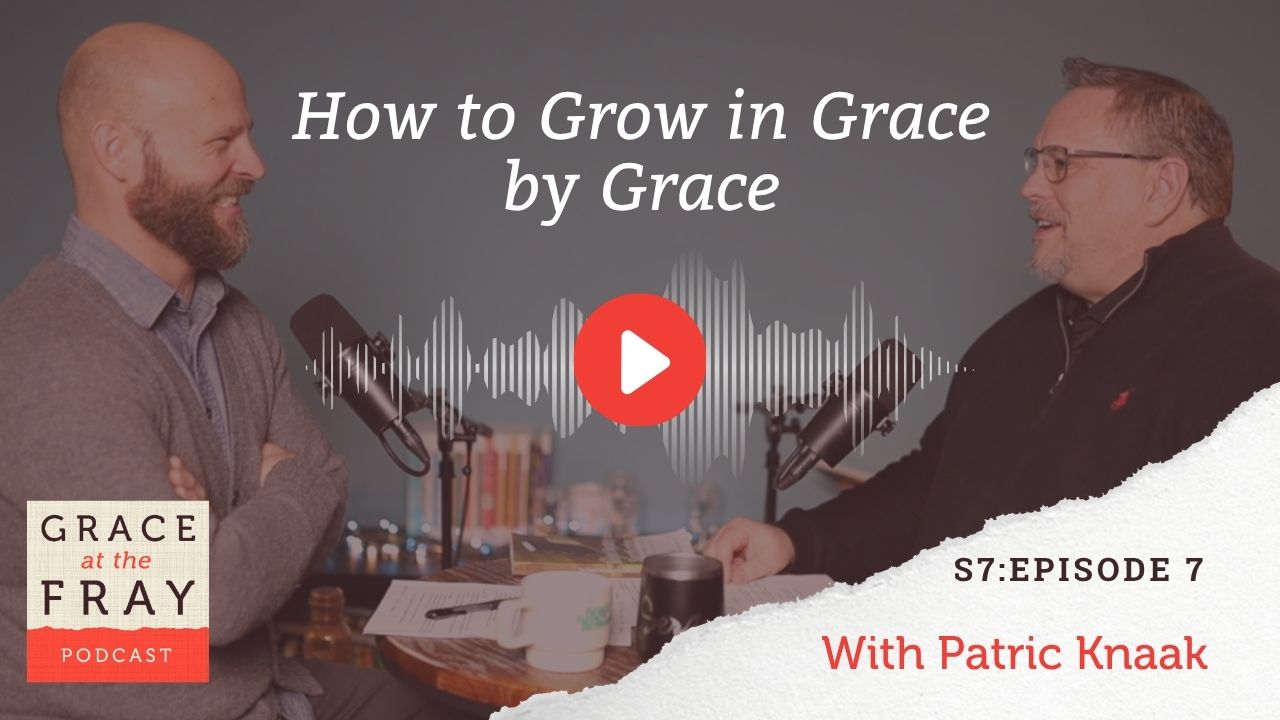
How do we actually grow in grace—by grace? In this episode, we explore how real transformation doesn’t come from trying harder, but from trusting more deeply. Jim and guest Patric Knaak unpack the counterintuitive nature of sanctification—and how the Christian life isn’t about becoming less dependent on Jesus, but more. Through everyday stories and biblical insight, we’re reminded that faith receives what grace provides. When Christ becomes the true object of our faith, even our weakness becomes the place where His grace meets us and leads us into freedom.




How do we actually grow in grace—by grace? In this episode, we explore how real transformation doesn’t come from trying harder, but from trusting more deeply. Jim and guest Patric Knaak unpack the counterintuitive nature of sanctification—and how the Christian life isn’t about becoming less dependent on Jesus, but more. Through everyday stories and biblical insight, we’re reminded that faith receives what grace provides. When Christ becomes the true object of our faith, even our weakness becomes the place where His grace meets us and leads us into freedom.
In this episode, they discuss...
- Faith Has an Object (08:18)
- Why Jesus Is Trustworthy (14:24)
- Faith as the One Essential Work (28:23)
- Misplaced Faith (46:16)
- Discouragement, Repentance, and Assurance (52:43)
Thank you for listening! If you found this conversation encouraging or helpful, please share this episode with your friends and loved ones. Or please leave us a review—it really helps!
Referenced in the episode...
- Deepen your understanding of faith with Mentored Sonship
- Read Repentance: A Daring Call to Real Surrender by Jack Miller
- Download our free e-book on Everyday Repentance
- Watch Everyday Repentance: The Pathway to Joy by Stu Batstone
- Listen to 𝘛𝘩𝘦 𝘎𝘰𝘴𝘱𝘦𝘭 𝘔𝘺𝘴𝘵𝘦𝘳𝘺 𝘰𝘧 𝘚𝘢𝘯𝘤𝘵𝘪𝘧𝘪𝘤𝘢𝘵𝘪𝘰𝘯: 𝘎𝘳𝘰𝘸𝘪𝘯𝘨 𝘪𝘯 𝘏𝘰𝘭𝘪𝘯𝘦𝘴𝘴 𝘣𝘺 𝘓𝘪𝘷𝘪𝘯𝘨 𝘪𝘯 𝘜𝘯𝘪𝘰𝘯 𝘸𝘪𝘵𝘩 𝘊𝘩𝘳𝘪𝘴𝘵
- Bible references: John 6:22-38, Ephesians 2:8-10, Galatians 2:20, Romans 7:13-20
Credits
Our guest for this episode was Deputy Director of Mission Patric Knaak. Patric is an author and ordained minister with the PCA, and has been with Serge since 2007. This episode was hosted by Jim Lovelady. Production by Evan Mader, Anna Madsen, and Grace Chang. Music by Tommy L.
𝑮𝒓𝒂𝒄𝒆 𝒂𝒕 𝒕𝒉𝒆 𝑭𝒓𝒂𝒚 𝑷𝒐𝒅𝒄𝒂𝒔𝒕 is produced by SERGE, an international missions agency that sends and cares for missionaries and develops gospel-centered programs and resources for ongoing spiritual renewal. Learn more and get involved at serge.org.
Connect with us!
Get in touch:
Questions or comments? Feel free to reach out to Serge’s Renewal Team anytime at podcast@serge.org
[music]
Welcome to Grace at the Fray, a podcast that explores the many dimensions of God’s grace that we find at the frayed edges of life. Come explore how God’s grace works to renew your life and send you on mission in His Kingdom.
[music]
0:00:22.3 Jim Lovelady: Hello, beloved. Welcome back to Grace at the Fray. “Here’s a fun question,” he says facetiously. “How are you doing in your growth toward holiness and Christlikeness?” Ah, what an uncomfortable question. But why is it so uncomfortable? It’s because it sets us up for a sense of failure, that we could do more to look more like Jesus. And then there enters this haunting suspicion that God is disappointed with me because I’m not measuring up. So it’s uncomfortable. But after today’s episode, I hope that the question of holiness and Christlikeness no longer sets you up for a sense of failure. But actually, I hope that it sets you up for new ways to receive and experience God’s grace, and that you start to detox from this idea that God is disappointed or frustrated with you because you’re not trying hard enough or, you know, I don’t know, whatever it may be. But here’s the thing. We all want to be more Christlike, and not just because we know it’s the right and holy thing to do, but because the Holy Spirit has quickened within us an understanding that this is what we’re made for. I’ve been crucified with Christ. I no longer live, but it’s Christ who lives in me. And the life that I live in the flesh, I live by faith in the Son of God who loved me and gave Himself for me. There is no greater joy than to be in the flow of God’s grace, experiencing His pleasure for you in the everyday moments of life. My guest today is Patric Knaak, and he and I were discussing, I guess in the hallway or maybe in his office, we were talking about a talk that he’s prepping for on how we grow in holiness and Christlikeness. And as we were talking, I was like, “Man, you have got to come in and do a podcast. I just want you to lay out this material that you’ve been talking about with me.” And so I told him to grab his notes and to bring them into the studio because I want to give him plenty of time to unpack the topic of sanctification, what it looks like that Jesus is making us more like Himself, and what it looks like to grow in grace by grace.
0:02:50.3 Jim Lovelady: Well, Patric Knaak, welcome back to Grace at the Fray. This is your second one, right?
0:02:55.6 Patric Knaak: Yeah. Gosh.
0:02:57.2 Jim Lovelady: It’s been a couple seasons, so it’s about time.
0:02:58.5 Patric Knaak: Well, I’m glad to be back. And I listen to all of them and enjoy all of them, so I feel a little intimidated. It’s like, gosh, now I’m back in the lineup here. I hope I got something to say.
0:03:09.8 Jim Lovelady: Well, I feel… I mean, I’ve been trying to get this conversation about the subject that we’re going to be talking about. I’ve been trying to get this for a while. And so the stars have aligned, as it were.
0:03:20.9 Patric Knaak: Yeah. Our travel schedules have aligned.
0:03:22.4 Jim Lovelady: That’s what it is. That’s what it is. It’s good to have you back. The first… Well, it’s a warmish day. This is the first warm day that we’ve experienced. We’re filming this in early spring.
0:03:34.4 Patric Knaak: Yep.
0:03:34.9 Jim Lovelady: And it’s been a long winter, man.
0:03:37.3 Patric Knaak: It has been. And there’s still some snow on the ground.
0:03:40.3 Jim Lovelady: Yeah. I mean, it’s raining. The snow is…
0:03:43.3 Patric Knaak: Melting.
0:03:43.5 Jim Lovelady: Is melting because of the rain.
0:03:44.9 Patric Knaak: Yep.
0:03:45.7 Jim Lovelady: So it went from snow to rain. So it’s a little bit dreary, but there’s some warm days coming. So this could be the last cardigan episode that I do.
0:03:55.9 Patric Knaak: I made it just in time.
0:03:57.1 Jim Lovelady: Yeah, that’s right. And it could be your last pullover. You’ll go back to the black polo, the legendary Patric Knaak black polo.
0:04:04.2 Patric Knaak: Yeah. Yeah. So for those who don’t know, all my shirts are black.
0:04:09.2 Jim Lovelady: It’s easy.
0:04:09.9 Patric Knaak: So, yes, I can get dressed in the morning without any lights on whatsoever. Every shirt I own goes with every pair of pants I own, because every shirt I own is black.
0:04:17.9 Jim Lovelady: That’s fantastic. I love it. So how was your winter?
0:04:21.1 Patric Knaak: You know, that’s an interesting question. So I grew up in Chicago, so I live in Philly now.
0:04:25.9 Jim Lovelady: You’re used to this.
0:04:27.0 Patric Knaak: Winters are not nearly as bad here as they are in Chicago, but we’ve lived here for almost 20 years, and so we’ve gotten soft. Like, that’s what we realize is we’re no longer suited for Chicago winters. And that was really driven home this winter because we had two really big snowstorms that were a couple weeks apart.
0:04:43.6 Jim Lovelady: Was this like a Chicago-style winter then? Because this was… I’m from the desert.
0:04:46.0 Patric Knaak: Yeah. Yeah.
0:04:48.6 Jim Lovelady: This is insane. This was insane.
0:04:50.9 Patric Knaak: Yeah. Well, if it was this cold right after Thanksgiving, two big snowstorms before Christmas, a stretch of six weeks where it didn’t get above freezing, another couple snowstorms before spring, then you would have a Chicago. There was a while a couple years ago where it was colder in Chicago than it was on the surface of Mars for like a three-week stretch in there. So this is not as bad as.
0:05:17.9 Jim Lovelady: Well, the Philly winter is like 34 and rainy.
0:05:21.5 Patric Knaak: Yeah.
0:05:23.9 Jim Lovelady: And that just, I’m like popping vitamin D like it’s going out of business.
0:05:26.3 Patric Knaak: Dead trees, dead grass, mud everywhere. So having snow to cover that up, it’s beautiful when it snows. The problem when it snows, though, at least for us, we don’t have a garage. So we have to dig our cars out, and we have a long walkway. And then where our house is, the road kind of curves, and so they never really plow all the way to the curb. So you have to dig out like four or five feet just to get to the road that has been plowed.
0:05:50.7 Jim Lovelady: That’s right. That’s right.
0:05:51.6 Patric Knaak: And then dig both of the cars out in the driveway to do that. So first snowstorm, we hadn’t had snow in a while, so I was out there, I was having a good time, but it was a lot of work. And I’m not as young as I used to be. And so when we found out we were getting another big snowstorm a couple of weeks after that, I was not in a good place. I was just like…
0:06:12.4 Jim Lovelady: Dreading the…
0:06:13.9 Patric Knaak: One was fine, one was novel.
0:06:15.3 Jim Lovelady: One was fun.
0:06:17.0 Patric Knaak: Yeah. Second one was a problem. And so it snowed Sunday night into Monday. We had over a foot and a half, which is a lot for around here. So I got up the next morning. I was not really looking forward to going out and digging everything out. Now, we had to, just necessity. You knew you had to do it. But also, I knew that this is one of the things that I’m called to do to love my bride and to take care of my family. And Jennifer’s recovering from a shoulder injury, so she was not gonna be able to shovel or get her car brushed off or anything.
0:06:50.2 Jim Lovelady: Do the dig out.
0:06:51.3 Patric Knaak: Right. So I was not excited about going to do it, but I was out there, I was doing it, I was getting it done. And as I finally got the walkway done, and so now I’m out in the street, and as I’m doing this, and if you would have seen me, all you would have seen was a guy out there shoveling snow just like everyone else.
0:07:10.8 Jim Lovelady: All the other people on the block. Yeah.
0:07:12.5 Patric Knaak: But internally, what I’m really thinking is, I cannot wait to be done with this. I got a lot of stuff I need to get done. This is such a royal pain. What a great husband I am for being out here doing the thing. And my next-door neighbor, who’s a single mom, came out, and she’s got the baby in the baby backpack, and she starts shoveling. And because Jesus loves me so much…
0:07:35.5 Jim Lovelady: He loves you too much.
0:07:38.3 Patric Knaak: Too much. It was as if I heard an audible voice say, “Go help her.” And I…
0:07:43.9 Jim Lovelady: Wait, so she was… How…
0:07:45.5 Patric Knaak: She had the baby backpack. So the baby was in the backpack, looking over the shoulder, and she was out there getting ready to start shoveling.
0:07:52.1 Jim Lovelady: Yeah. So, yeah. Jesus, you love me too much.
0:07:56.7 Patric Knaak: Well, it was not subtle. Jesus is subtle sometimes, but this was…
0:08:00.2 Jim Lovelady: This was not subtle.
0:08:01.4 Patric Knaak: Yeah. He’s like, “Go help her.” And I’m like, “Yes, I know I should, but I really don’t want to.” And so that moment, as I was kind of standing there feeling convicted but hadn’t yet started to obey, that brought me back to a book that you and I and some of the rest of the folks in renewal have been reading, which is an old Puritan classic.
0:08:23.9 Jim Lovelady: Okay. Right. Yeah.
0:08:25.9 Patric Knaak: Yeah. So The Gospel Mystery of Sanctification by Walter Marshall.
0:08:29.6 Jim Lovelady: I love that snow shoveling brings you back to Walter Marshall. How old is this book? Like 400, 500 years old?
0:08:35.4 Patric Knaak: Yeah, it was mid-1600s when he was writing.
0:08:37.5 Jim Lovelady: Right. So he’s on your mind.
0:08:39.7 Patric Knaak: As one does. As anyone, I think. No, it just shows you how weird my mind works. So one of the things that is interesting about this book, so Walter Marshall, for folks who don’t know, he was a pastor in England, Puritan, and he saw people really struggling to grow in their Christian faith. And so he’s really writing to address why do you struggle so much, and how does scripture talk about how we grow, and really the essential nature of faith to make us more like Jesus. And so we’ve been thinking through that. And because faith is what unites us to Christ, faith is really the conduit or the channel by which we receive all the benefits and blessings of the gospel. But it’s also the way the Holy Spirit works in our hearts, works in our minds, works in our lives.
0:09:30.8 Jim Lovelady: Yeah, I love that we’ve been wrestling with this through reading the book because it is a thing that is on so many people’s minds. How do I grow? How can I grow as a Christian? How can I become more like Jesus? And that question is, when I hear that question from folks, it’s normally asked with this sense of a burden instead of the kind of invitation that I think it’s meant to be, this joyful invitation.
0:10:01.7 Patric Knaak: Well, and it comes out a lot in my life when I see areas of disobedience or places I really want to see growth happen, and it doesn’t seem like there’s a lot of progress happening. And so I’m like, what do I do with that? I have some part to play. What is my part to play?
0:10:15.6 Jim Lovelady: But it is ironic that that came up as… This whole topic came up as you’re shoveling, as you’re doing this thing that you don’t want to do.
0:10:22.7 Patric Knaak: Right.
0:10:23.4 Jim Lovelady: That’s when Jesus is like “Hey…”
0:10:25.2 Patric Knaak: “Let’s go be missional. Let’s go love your neighbor together to do this.” And internally, I’m like, “Oh, I’m not sure that’s what I signed up for this morning.” And yeah, so.
0:10:35.6 Jim Lovelady: “Maybe I should go read Walter Marshall a little bit more before I help her.” Jesus is like, “No, now. Now is the time. Today is the day of salvation.”
0:10:44.5 Patric Knaak: “You got enough knowledge, big guy.” So one of the things that Marshall talks about, one of the things that we talk about a lot at Serge, we do this through our Mentored Sonship program or when we’re training disciplers, when we’re working with other national pastors out on the field, is what’s the role of faith in helping us grow to become more like Jesus? I think one of the things that I don’t know if I misunderstood it or just kind of knew it and forgot it early or just didn’t really know what to do with it, but it was this idea that our faith has an object. And so if you ran across Susie, Susie’s here in the studio, she’s a little girl, she’s sitting on one of the chairs, and she’s just beaming with pride and joy and so happy. I’m like, “Susie, you look like you’re in a really good mood today.” And she’s like, “Oh, I am.” “Well, how come you’re in such a good mood?” “I’m in love.” Like, “Well, who are you in love with?” She goes, “No one.” “What do you mean, no one?” She’s like, “I’m just in love.” I’m like, “Well, Susie, love doesn’t really work that way. Love has an object. You are in love with someone.” Faith works in a similar sort of way. Faith has an object.
0:11:52.7 Jim Lovelady: I don’t just have faith.
0:11:54.0 Patric Knaak: Right. And so who we choose to put our faith in and what we believe about that person really has a remarkable influence on how we understand God, but also how we will grow in our relationship with him. And so Marshall really talks about how faith is really the conduit for experiencing our union with Christ, which means that Christ is the object. He is the one proper object of our faith. And so Jesus is really making that same sort of point when He talks about Matthew 17. And the disciples had tried to do a miracle, hadn’t worked, and Jesus is like, “Do you guys… What is wrong? So little faith.” And so He says, “Because you have so little… Why didn’t it work? Well, because you had so little faith. Truly I tell you, if you have faith as small as a mustard seed, you can say to this mountain, ‘Move from here to there,’ and it will move. Nothing will be impossible for you.” Now, back in the day, mustard… So this is pre-microscope, pre-corrective lenses. A mustard seed was almost kind of the smallest sort of visible thing that you could see. I mean, maybe if He was saying it today, He would say, “If you have faith like a nanoparticle or…”
0:13:13.8 Jim Lovelady: Like a string theory thing.
0:13:16.7 Patric Knaak: Right, right.
0:13:19.5 Jim Lovelady: Way to go, science Jim.
0:13:20.7 Patric Knaak: Right. Well, it’s…
0:13:23.1 Jim Lovelady: The smallest thing, whatever the smallest thing is.
0:13:25.4 Patric Knaak: Yeah. So be sure to put it in the show comments, how wrong we were about that.
0:13:29.0 Jim Lovelady: That’s right.
0:13:30.2 Patric Knaak: But Jesus’ point is like, it’s not the quantity of the faith. It’s not how intensively you’re trying to believe or achieve something. It’s what’s the object of the faith? What are you putting your faith into? He’s saying, “If you have the right object,” i.e. Me, “The tiniest amount of faith is super effective. Because your faith is so great? No, because the object of your faith is so great.” And so Marshall is drawing that out in several different ways all throughout the book. And so that idea that what we put our faith in, who we believe, who we are going to trust, who we are going to receive from, is critical if we’re going to grow in the ways that scripture paints for us to grow. So that idea, object of the faith, that came another winter sort of story. So way back in the olden days when I was in grad school in Chicago, and I had grown up in and around Chicago, so I was used to Midwest winters. But one of my good friends had grown up in Kenya, and he was just from a part of the country where there just was not snow and ice, certainly the way that there is in…
0:13:45.4 Jim Lovelady: Right. In Chicago.
0:14:43.3 Patric Knaak: Yeah, yeah. So he has seen it. He knows what those things are. But it was a particular cold snap, and we were driving to school, and there were some kids out on one of the retention ponds that had frozen, playing hockey. And we had to pull over. Like, he was just…
0:14:59.6 Jim Lovelady: What is happening?
0:15:00.4 Patric Knaak: Yes. Like, he’s like, I know that this can happen. Like, I’ve seen on TV or whatever it happen. I’ve never seen it in real life. So we pull over and go walking out there, and this just felt very normal to me. Like, I would have been… When I was a kid out there, skating, playing hockey. And so we go walking right to the edge, and I just walked right out on there. And Philip was like, “Whoa, wait, no, no.” And I’m like, “No, no, it’s fine. It’s frozen. It’s not a problem.” And so I’m trying to persuade him to come out on the ice, and he’s willing, but he’s very hesitant. Like, just one foot, a little bit, leaning back, testing it out, and gains a little more confidence. And so finally, I get him out, and we’re both standing on the ice. So in the illustration, what’s going to determine whether we’re able to stand on that ice? My confidence or his hesitancy? Which one of those things is going to be most determinative?
0:15:57.3 Jim Lovelady: Neither one.
0:15:58.1 Patric Knaak: Neither one. It’s the thickness of the ice. The ice is the object of our faith, if you will. That’s the thing that we’re relying on. And so if I had all the confidence in the world and was putting it in a bad object, ice that was a couple of millimeters thick, it doesn’t matter how confident I am. I’m going to step right through and go right through. Likewise for Philip, if he is afraid, scared to death, does not want to be out there, and yet the ice is very thick, is his hesitancy going to cause him to go through? No. It’s what are you putting as the object of your faith? What are you putting your trust in?
0:16:30.5 Jim Lovelady: It is interesting how you enjoyed that, and he was anxious about that. And because you had a confidence in the object, you had a confidence in the ice, and it kind of freed you to enjoy this. And like, “No, come on, I’m serious. This is dependable. Come on. Come on out.” And you had to coax him. And he probably never had the same kind of confidence. It was probably anxiety into a sense of amazement, which I think that those are normal emotions as we’re experiencing what trusting Jesus looks like and learning how to trust Him in greater and greater faith. So that makes sense.
0:17:11.6 Patric Knaak: Well, it was one of those classic “I believe, help my unbelief” type moments. It’s like, I see other people out there, Patric has stepped out there, and so how do I really start to understand that? So why does all of this matter? Well, Jesus isn’t just a static object to our faith, right? He’s not like ice that’s just passively out there and that we’re making decisions. He is a person who is running towards you. He is a person who’s able to communicate to you, to help us understand more about who He is and what He’s done. And there’s just… The older I get, the more endlessly fascinated I become with Jesus. And there’s so many things, like if you think about this, we’re trusting Jesus for our eternal destiny here. And there’s so many things we don’t know about Jesus. How tall was Jesus? Was He right-handed or left-handed? What was His favorite food? Could He carry a tune? Was He a good singer or not a good singer? All these things that, and there are objective answers to that, right?
0:18:18.6 Jim Lovelady: Yeah, yeah.
0:18:19.2 Patric Knaak: If Peter was here, he could say, “Oh, I know how tall he is, and I know what his favorite food is, and I know if he’s right or left-handed.” But we don’t know those things. Well, why? They’re not in scripture. Well, why aren’t they in scripture? Did they run out of paper? No, it’s because Jesus says, “If you’re going to trust me for your eternal destiny, here are the things you need to know about Me: fully God and fully man. I came to live a perfect life and fulfill the law because you can’t live a perfect life and fulfill the law.” So it’s all of those rich sorts of scripture ideas. And so when we think about Jesus as the object of our faith, it’s not just this thing out there that we’re trying to understand. It’s this person who has revealed Himself to us, and in revealing Himself to us, is also revealing why He’s trustworthy. And the way that we go about having more confidence, if you will, or understanding just how trustworthy He is is through doing all of these sorts of things that I think sometimes we get mixed up in. But reading scripture, going to worship, taking the sacraments, praying, all of those things that are in scripture that Jesus tells us to do. So we’re doing the right things, but I think we’re doing them with a misunderstanding of what they’re supposed to accomplish, what’s the right role of those things in our lives. So that, and the ice illustration is a good thing. The kids who are out there playing hockey, they were not worried about the ice. They were freed into the play of the game and to what they were doing because they knew that they had put their confidence in the right object. And now if you live someplace where it doesn’t get that cold, if it was a really big pond, if it was a river with rapidly moving water, there’s a lot of places where I’d be like, “I don’t know if you really want to be out there on that ice.”
0:20:10.9 Jim Lovelady: Right. Is that wise?
0:20:12.1 Patric Knaak: Yeah, yeah. But in this case, super cold winter, it was very easy to tell this is a very safe place to be as they were doing that.
0:20:21.8 Jim Lovelady: Before we move on to some of the other questions that I have, there’s this sense of what faith, like the saving faith, and how that is working itself out. And you and I had talked about some talks that you’re getting ready to give and how it’s like the Ephesians 2 passage, “For by grace you have been saved through faith. This is a gift, not of yourselves.” How does that play into this?
0:20:50.0 Patric Knaak: In my own life and Christian experience, that was one of those things that it took me a long time to really understand all that salvation involved and what my right response was throughout the whole process of salvation. And so Ephesians 2:8-10-ish, that’s a great grounding sort of passage because Paul is being very direct there. And so when he says, “For it is by grace you have been saved through faith, and this is not from yourselves, it is a gift of God, not by works, so that no one can boast.” And then he goes on in verse 10, “For we are God’s handiwork, created in Christ Jesus to do good works, which God prepared in advance for us to do.” So how do we become saved in such a way so that we get to enjoy that game of hockey, the good works, the things we were created to do, the things that are the biggest, most satisfying, best expression of who God has made us to actually be? And so one of the things that’s easy to forget is salvation has a beginning and a middle and a completion. And so in Ephesians, when it says, “For by grace you have been saved,” I think for a lot of time I read that as really only applying to the beginning part, you know, you…
0:22:07.1 Jim Lovelady: Like, that happened back then.
0:22:09.3 Patric Knaak: Right, yeah. So when I first accepted Christ. And here’s why this is important: the beginning part of salvation, we are entirely passive. All we can do is receive. And so dead in our sins and trespasses, enslaved, blind, up until the point when Jesus regenerates us, we don’t have faith, we don’t have the capacity to respond with faith. We are simply there waiting spiritually to be raised from the dead, to be given faith, which comes from God. And as He gives it to us, then we start to move into this middle section. So that’s the beginning of salvation. The middle section, now it changes. Now we can cooperate. Before we had been regenerate, all we could do is receive. Now we have a part to play, but the receiving is still the main part of what we need to play. And so it’s a little hard to work that out and say, what do we do? What does God do? How do we know what that looks like? So I want to come back and talk about that. But the completion of salvation returns us back to that passive posture again. So whatever Christian growth I’ve experienced on this side of Heaven, it is not enough to actually make me fully like Christ the way I will be when I get to Heaven, when, you know, and with glorification is kind of the theological term that we use for that. If for whatever reason God granted me a thousand-year lifespan, I would not be glorified as a result of living for those 1,000 years.
0:23:36.1 Jim Lovelady: Right.
0:23:52.0 Patric Knaak: Right? I still need a supernatural work of grace to complete the salvation that was begun. And so when we talk about gospel, gospel applies to all of those things. The gospel isn’t just the gate that we walk through, the beginning of salvation. It’s the path that we walk along. And so sanctification, growing in grace, growing to become more like Jesus, this middle part, as well as the destination that we arrive at, fully like Christ, fully able to enjoy Him and glorify God forever. And so we can see at the beginning and the end how our primary posture is receiving. We’re passive. It’s in the middle where we have an active part to play where I think we can get off track.
0:24:35.8 Jim Lovelady: That’s super helpful because I think one of the most common questions that I get as a pastor is, “What’s my role to play? Aren’t I supposed to be doing something?” And it’s always, again, this is a question that comes kind of with a sense of burden instead of going back to the ice hockey stuff, it’s like, “The lake is frozen over. Can I go play tomorrow?” You know, like this excitement of the… The lake is dependable. You can play on the lake. You can have so much joy, so much fun. Let’s go. But it’s more like the sense is, don’t I have a role to play here? Aren’t I supposed to get busy doing something until Heaven comes? And it’s always this burden. So, yeah, that was kind of my next question of, all right, what does it look like to talk about our role in this middle part?
0:25:29.8 Patric Knaak: Well, and that’s where Marshall is so helpful. Later in the book, in one of the chapters, he uses this kind of unusual phrase. We don’t really use this very often in modern lingo, but he talks repeatedly in section headings as sanctification, so growing to become like Jesus, sanctification by grace through faith. And in one of those chapters, he just repeats that over and over again. Now, it’s a hallmark of Protestant theology to talk about justification by faith.
0:26:01.1 Jim Lovelady: Right, right.
0:26:01.5 Patric Knaak: And part of what Marshall is reminding us is that that same gospel that saved you is the same gospel that grows you. You receive the gospel that saves you by faith. You receive the gospel, you appropriate it into your life, you live it out by faith as well. And so, I think like the first, way back when I first started to run into this idea, I’m like, “Okay, maybe, but prove it.”
0:26:29.1 Jim Lovelady: Right, right. I’m listening.
0:26:29.8 Patric Knaak: Yeah, yeah. Well, when you look at what Paul is saying grammatically in that Ephesians 2:8-10 passage, when he says, “You have been saved,” he’s using a very particular Greek construction there. So it’s a perfect participle. And for those of you who are not theo nerds or grammar nerds, which I’m a theo nerd, but my grammar’s not very good, but I checked it out with the experts.
0:26:53.7 Jim Lovelady: I don’t talk good either.
0:26:55.1 Patric Knaak: Well, I worked hard to be sure that this is right. So this is a very unique, so it’s a past tense in Greek, but it’s a very particular type of past tense that combines two types of action. So generally speaking, in Greek, there’s punctiliar action, something that happens at a particular point in time, has a beginning, middle, and end. “I went to the store.” I was not in a state of going to the store for years at a time. At this point in time, I went to the store. Right?
0:27:21.5 Jim Lovelady: “I went to the store.” “How long have you been there?” No, that’s not the sensitive…
0:27:25.0 Patric Knaak: Right. So that’s the punctiliar action. Then there’s linear action that describes a long state. I lived in Pennsylvania. For a day or a week or a month? No, for years and years, I lived in Pennsylvania. And so the perfect really combines these two things. It’s almost like a wedding. At one point in time, I had a wedding ceremony where I married my wife Jennifer. That inaugurated an ongoing, continuous state of marriage that exists up until now and will continue to exist in the future.
0:27:56.6 Jim Lovelady: Right.
0:27:57.0 Patric Knaak: So if we’re going to translate that a little bit more literally: “For by grace you have been saved, you are now being saved, and you will continue to be saved.” How? Through faith.
0:28:08.8 Jim Lovelady: Through faith.
0:28:09.8 Patric Knaak: And so it’s the beginning, middle, and all of that happens through faith.
0:28:16.9 Jim Lovelady: I want to pause this conversation and invite you to join us in prayer for the Serge field workers that we at the headquarters here in Philadelphia are praying for each week. We meet on Tuesday and Friday mornings to pray, and this week we’re praying for our teams in Japan. Would you pray with me? Lord, we pray that you would bless these folks, grow them in holiness and Christlikeness, grow their sense of complete and utter dependence on You. Give them joy in their work in Your Kingdom and the pleasure of Your joy as they follow You. Give them wisdom and let Your grace abound in their relationships with one another, with family members and children, and with the people that they serve. Heal all sicknesses, liberate the enslaved, protect them from the powers and principalities of darkness, and restore to them the joy of Your salvation. And let Your Kingdom come and Your will be done in these places, just as it is in Heaven. We pray in Your name. Amen. And now back to the conversation.
0:29:23.3 Patric Knaak: So in this middle section, what do we do? What is our role to do? What is it that we’re actually called on? And so I think one of those things that is easy to mistake, I certainly thought about my Christian life when I was younger this way, is, what am I supposed to do? Supposed to do the right things and obey the rules, which will eventually make me better and better so that I need Jesus a little bit less and less. I don’t sin as much. I don’t have to confess as much. I don’t get it as wrong as much. And as that happens, over time, I get to the place where I can kind of make it work. Now, of course, not perfectly, you’re still gonna mess up. So Jesus is there, He forgives those things. But on an average day, nine times out of 10, you should kind of be able to do it on your own. And that’s where spiritual growth doesn’t really model other types of growth that we experience in our life. If you went to college to become an engineer and you took calculus as your course your freshman year, the goal of taking your calculus course is not to become dependent on the professor who teaches you calculus. It’s to learn how to do it on your own so you don’t need the professor.
0:30:33.7 Jim Lovelady: There’s a proficiency that is the goal here.
0:30:35.8 Patric Knaak: Yep. And in spiritual growth, it works almost exactly the opposite. One of the chief characteristics of being a new creation in Christ is to be dependent on God for everything, all the time. And in ways that are not that sad sort of necessity, “Oh, I guess I can’t do this. I guess I’ll have to rely on Jesus,” but where that’s the first impulse, where that’s the most joyous thing, we’re becoming dependent, we really see that as the goal of the things that we’re doing, the actions that we’re doing.
0:31:11.7 Jim Lovelady: The way Jesus was perfectly dependent on His Father. “I do nothing without dependence on my Father.”
0:31:19.4 Patric Knaak: Right. And so for a long time, I tended to think of dependence as a sign that I hadn’t really grown. And that when I do grow, I won’t need those training wheels. I’ll be able to do it all on my own. But if you read through the Gospel of John, I mean, this is a fascinating devotional something if one of our listeners wants to do it, just read through the Gospel of John and highlight every time Jesus talks about being dependent on the Father. I mean, it’s fascinating. “I’ve come to do the will of my Father. I speak only what my Father tells me to speak. All those that my Father has given me, I will hold on.” And so over and over and over again, Jesus is showing perfect humanity is perfectly dependent, is most satisfied, is most fully alive when God is the object of our faith and we’re completely dependent on Him all the time for those things. And Jesus knows that that’s the case. I mean, He knows that that’s gonna be one of the struggles, because in John 6, so He’s just… miracle, you know, fed thousands of people.
People have showed up again to get some more bread. And He’s saying, “Hey, you’re really missing the point here.” And so Jesus says to them, “Very truly I tell you, you are looking for me, but not because you saw the signs I performed, but because you ate the loaves and had your fill. Do not work for food that spoils, but for food that endures to eternal life, which the Son of Man will give you. For on Him, God the Father has placed His seal of approval.” So He’s talking about salvation here. He’s like, “You’re missing it. You’re looking at the miracle, but you’re confusing that with the substance. Substance is me and what I offer you in terms of spiritual life, spiritual nourishment.” And so the crowd asks Him, “What must we do to do the works God requires?” How do we get this salvation, Jesus? What are the works we need to do?
0:33:18.1 Jim Lovelady: What’s my role?
0:33:18.8 Patric Knaak: Yeah, what am I supposed to do? And Jesus’ response is so telling. They ask, “What are the works?” Jesus replies in the singular, “The work of God is this: to believe in the one He has sent.” And so Jesus is saying, what is our role in Him being our Savior and us growing in that capacity? Singular. So there’s only one work, and it’s faith. And faith is largely receiving. And probably no one would disagree with it. Like, you hear it, we’re in the studio, you say that, you’re like, “Right.”
0:33:51.3 Jim Lovelady: Oh, yeah, totally. I affirm that.
0:33:52.6 Patric Knaak: Yeah, yeah. Faith is receiving. But so often, my flesh, my fallen heart wants to redefine it, that faith isn’t receiving or just receiving, it’s also achieving. It’s also the things I need to… Just exactly like that original, “Jesus, what things do I need to do to be acceptable to you?” And He’s like, “There’s only one thing, and you need to believe in me. I need to be the sole object of your faith in every area, big and small.” And so understanding that that’s kind of how the table is set, I think, is what sets us up to understand, okay, this is how Christian growth actually happens and takes place.
0:34:35.7 Jim Lovelady: So talk to me about obedience. Because when we say, “What’s my role?” There’s almost this underlying assumption of like, I know what you’re gonna say. It’s to obey more, right?
0:34:48.6 Patric Knaak: Right.
0:34:50.2 Jim Lovelady: Okay, so I guess I’m just gonna have to… And that’s part of the burden. You’re giving a lot of really good keywords that it’s like, okay, well, what do we mean by that word? What do we mean by that word? So here’s another word. What do we mean by the word obey?
0:35:01.8 Patric Knaak: Yeah. Well, and especially because we are in the point of working out our salvation, we are in that stage of it where we are called to actively participate. And so how do those things work out? So it’s really interesting, when I’m teaching or leading a retreat, lots of times I ask this question, “What would it look like if you really grew in your faith?” And so we’ll have a little group conversation, and lots of times what you’ll hear is, “Oh, I’d read my Bible more, I’d pray more.”
0:35:32.0 Jim Lovelady: Always answer number one.
0:35:33.3 Patric Knaak: Yeah, yeah. “I’d give more, I’d be more loving to my family, I’d care more about the law,” all of those sorts of things, which are good things. And so then I ask the follow-up question, I’m like, “So if that’s what it would look like, what are you gonna do to get to that place?” And the lists look pretty identical. “Oh, I need to read my Bible more, I need to pray more, I need to give more.” And so we confuse, I think, sometimes means with the outcome for what they’re supposed to be doing. Not only that, in the New Testament, there are wonderful active images for what we’re supposed to be doing. I think sometimes when folks think about grace, there’s a misunderstanding that if we really want to talk about growing by faith, and all of this happens by grace, so sanctification by grace through faith, the misinterpretation, and Marshall talks a lot about that in his book too, is, so we just don’t do anything. It’s whatever, it’s all happening, we’re just receiving it, so there’s nothing for me to do. Let go, let God, and you’re free to do these things. So we fall in the ditch that way.
0:36:43.0 Jim Lovelady: That’s right.
0:36:44.1 Patric Knaak: So that’s kind of antinomianism. Obedience isn’t important, you don’t need to pursue it, you don’t need to do anything. Or we fall in the ditch the other way, where it’s like no, you do all these things, and if you do all these things right, then you will grow, and then you will be acceptable, and then you will… And so really, when we read all of these great active words in the New Testament, so run the race, fight the good fight, put to death the flesh, talks about putting on these things, putting off these things, walking in our relationship with Jesus, “I’m the vine, you’re the branches.” All of those things that we are to do, that we are called to do, and that we now, as new creations in Christ, have some capacity to do, all of them are designed to make us more dependent, to allow us to become better receivers. And if we don’t understand that that’s the function of those, then faith starts to go from receiving to achieving. And lots of times when we work with someone and we’re mentoring them, there’s this subtle sort of tell that we’re looking for. And people don’t necessarily come out and say it this way, but you can draw it out of them if you talk for a little bit. And it kind of goes like this: “I know God loves me, right? Jesus died on the cross for me, He raised again. I know that God loves me, but I don’t feel like He likes me very much.” And so when they say, “I know God loves me,” they’re really saying, “My justification is secure.”
0:38:20.8 Jim Lovelady: That’s right.
0:38:21.5 Patric Knaak: It has been accomplished, it has been declared over me, I’ve received that by faith.
0:38:25.2 Jim Lovelady: It’s a signature on that, stamped. It’s official.
0:38:26.9 Patric Knaak: Yep. I know that when I die, I’m gonna go to Heaven, not because of what I’ve done, but because of who Jesus is and what He has done for me.
0:38:34.3 Jim Lovelady: Yes, it’s assurance in the beginning and the end part of the salvation.
0:38:39.1 Patric Knaak: Yep, yep. And so they see that part. But the “I don’t think God likes me” usually starts to come down to, “I see the mess that I make in my life every day, all the big and small ways that I don’t obey, or that I feel powerless, that I feel trapped. I’m stuck in an addiction, I’m not able to break free. Things I know that I’m called to do,” right? The whole classic Romans 7 things I know I’m called to do, I don’t do them; things that I don’t want to do, I end up doing them. And so you get that sense of like, well, how could God be pleased with someone who’s doing that? Essentially, our sanctification starts to define our justification. How we are relating to Jesus every day starts to change the way we think of our status before God. And those two things are never reversed, right? We always live out our relationship with Jesus based on what He has done, how He has established that for us. And so this idea that there are things that we are called to do, that we should be doing, but those don’t establish our identity. And the purpose of those is for us to become more dependent on Jesus. And so sometimes I’ll talk about it this way with folks and I’ll say, “Think about if you are paddling a canoe in a wide stream that had a pretty strong current right in the middle of it.” And so the things that we’re called to do, those active parts of obedience, it doesn’t mean turn the canoe around and try and paddle upstream.
0:40:09.4 Jim Lovelady: That’s right.
0:40:10.0 Patric Knaak: That’s disobedience.
0:40:10.9 Jim Lovelady: That’s right.
0:40:11.6 Patric Knaak: It doesn’t mean take the canoe and paddle it over to the side and pull it out of the water and try and drag it through the woods down the… So if disobedience is paddling upstream, trying to pull the canoe out, that’s kind of the license sort of thing, or your own self-generated righteousness.
0:40:27.9 Jim Lovelady: Yeah, well, the whole thing is, “I’m gonna do this myself.”
0:40:29.8 Patric Knaak: Right. It’s my power that is going to get this canoe where it needs to go. I think the much more apt way to think about that, you could call it maybe willed passivity, or the way that I like to think of it is active receptivity. And so the goal, do you paddle? Yes, you do. But the power to move the canoe, to move your life downstream is coming from the current. That’s the Holy Spirit. And so our efforts are always, how do I stay in step with the Spirit? Repentance is, “Oh, I’m getting too close to the edge,” or, “The rocks are getting tangled up.” Paddle away from that, paddle back to the center where the Spirit’s power is active, where it’s moving. Now, am I forcing the canoe to go downstream? No, there’s a power source outside of me that is able to accomplish things that I just through paddling am not able to accomplish. And yet I have a very critical role to play in doing that. And analogies break down, so the Holy Spirit is there. The Holy Spirit isn’t just some unseen force the way that the current is.
0:41:45.2 Jim Lovelady: Right, right.
0:41:45.8 Patric Knaak: The Holy Spirit is also your spiritual GPS. “Hey, you’re getting too close to the edge. Come back. Hey, come cooperate with me in this way. Hey, you’re putting your faith in the wrong object.”
0:41:58.6 Jim Lovelady: Yeah, yeah, yeah.
0:41:59.2 Patric Knaak: “That will not help you. It’s not gonna go the direction that you think that it should.” So it isn’t just the power, the help that He’s giving in terms of accomplishing. It’s the directions, it’s the companionship, it’s the, “I know you’re tired, but I know what’s around the bend and it’s okay and I’m with you.” Or when we see the rocks and the waterfall and we’re like, “Holy, what’s gonna happen now?” and Him saying, “I got it. I am here with you. You need to listen to me, depend on me, stay in the middle.” When our son Parker was a little toddler age, we’re getting him dressed and, “No, no, I can do it.” He’s trying to put the shirt on and he’s got his arm and his head in an arm hole and he’s walking around and banging into things. You’re trying to help him and he’s fighting you. He won’t let. And then finally, in frustration and exhaustion, he comes over with the shirt, hands it to you, and puts both of his arms up and says, “Okay, put it on.”
0:42:57.3 Jim Lovelady: Yeah, yeah.
0:42:58.2 Patric Knaak: So it’s really that. Now, he didn’t have the capacity to figure out how to get the shirt on on his own, but him coming, being dependent, being receptive, him saying, “My dad knows how to do this and he cares for me and he’s the one who can accomplish this. All I really need to do is to come to him with open arms and be willing to receive the goodness that he is willing to provide for us.” So when we start to think of growth that way, it radically reframes not just what we do, but why we do it, how we do it, what we think is gonna happen as a result of doing it, and what happens when we disobey, what happens when we fail to do. The gospel radically changes all of those sorts of things, and it does it so that we can become 100% dependent on Jesus. I think the biggest difference between now and when I’m glorified and become completely like Christ, dependence will be both the natural heartbeat that I have, the thing that is most natural that I want, and the thing that is most satisfying that I have. And so to go from that place where sometimes I see that a little bit here in my life, often hesitantly recalibrating, having to be reminded over and over, but imagine a time where your sin doesn’t get in the way of your dependence, where being with Jesus and wholly dependent on Jesus and knowing how trustworthy He is, because we can see with eyes of faith that, “Hey, that ice isn’t a couple inches thick. It’s not even a couple feet thick. It’s miles and miles thick.” And so the things that we’re called to do that aid our growth, and they do aid our growth. Should you read scripture? Yes, you should read scripture. Why? It’s God’s word. He tells us to. If you want to know what God thinks about you and His people and the world, where do you go? You go to scripture. Should you pray? Should you talk with God? Yes, all the time. Why? He tells us to, but He’s won that right and privilege for us to have that type of intimate relationship with Him. But those are the things that they help us drill down into the ice to see how trustworthy it actually is. They don’t make the ice thicker. They don’t make us better able to stand on our own. They help us understand the true nature of reality as it has already been. And the sad thing is I often make other things the object of my faith. And when I do, it never goes well.
0:45:35.9 Jim Lovelady: Yeah, it’s interesting to think about how easy it is for me to go, “Oh, I want to sit down and read my Bible and I want to pray because that brings me back into the flow of the Holy Spirit and the joy of participating in tandem with the rhythm of God working in my life and in the life of the people around me.” But there’s so often where I go, “Man, look how much I’m praying. Look how much I’m reading my Bible. Man, look at me.”
0:46:12.1 Patric Knaak: Yep.
0:46:14.4 Jim Lovelady: And it’s like, oh, you were using the Bible to poke holes in your canoe and you’re gonna sink, you know.
0:46:19.8 Patric Knaak: Right. Yeah, yeah, yeah. The thing that the canoe is supposed to allow us to do, go downstream, become more like Jesus, we are self-sabotaging through substituting our own effort, our own prerogatives instead of what God has…
0:46:36.9 Jim Lovelady: Yeah. Give me some examples of that.
0:46:39.2 Patric Knaak: Well, so what are some telltale signs that we have a misplaced object of faith? So instead of Christ being the object of my faith, I’m looking to something else. I’m putting my trust in something else.
0:46:49.7 Jim Lovelady: In my Bible reading, or whatever.
0:46:50.9 Patric Knaak: Right. So in my life, that can happen with things that are related to self. So my own effort, achievements, abilities, discipline, accomplishments. And so we start to mistake, “Here’s something that I do that should make me more dependent.” Instead, when I misplace my object and I become the object of my faith, my gifts, my abilities, I become not more dependent, but more independent. “Look at me. See what I’ve accomplished. See what I’ve done.” And Paul knows that very well because in Philippians 3, he really points that out, right? He gives this whole long list, seven things: Hebrew of Hebrews and tribe of Benjamin, all the rest of these qualifications, saying all of those things, as good as they are, compared to what we receive from Jesus, His rightness, His righteousness, they’re as excrement, like human waste compared to that. And so when we misplace our object onto ourself, we’re really becoming our own sort of functional savior instead of running to the one who is our Savior and learning to depend on Him by receiving by grace through faith. So sometimes it’s self, sometimes it’s others. Like, I put my hope in other people. Anytime I’m putting my hope in something other than Jesus, myself, other people, systems, objects, accomplishments or whatever, anytime I’m putting my hope in something other than Jesus, that’s a misplaced alignment of faith. And so in my life, when I’m putting my faith in other people instead of in Jesus, then it starts to show up with, “I wish I had a better team,” or, “a more supportive spouse,” “I wish I had kids that turned out the way that I want them to turn out because I did all the right things.” and…
0:48:37.1 Jim Lovelady: Self-pity just all over the place.
0:48:38.7 Patric Knaak: Well, or just that sense of, “I played by the rules, I’m supposed to get rewarded. What’s going on here? How come these people are not getting with it?” What did I want in the shoveling analogy? What did my heart really want when I was done and came back in? Praise, gratitude, a day of put your feet up and…
0:49:01.1 Jim Lovelady: Some hot chocolate.
0:49:01.4 Patric Knaak: Yeah, yeah. All the rest of the work that you still need to do because it’s a Monday, you don’t have to worry about any of that. None of that needs to happen. You’ve accomplished the big…
0:49:09.5 Jim Lovelady: You have ascended. Patric is lord of the shovel.
0:49:12.7 Patric Knaak: Right. And when Jesus was saying, “Come, love your family in this way, and then love your neighbor in this way,” He’s saying, “We’re going to do this together.” That is the reward. That is the best thing you could have, so that should also be the thing that you want, instead of looking to it for these other people. I think sometimes I misplace my faith by putting it into systems or processes. And that’s really the, “If you will do this and do it this way functionally, that’s what saves you. That’s what will give you the good life. That’s what will make everything possible.” And it mistakes the purpose of doing those, even if you’re doing good things. So I’m reading my Bible every day for 30 minutes. Is that a good thing? Yeah. Should you want to do it? Yeah. Will you benefit from doing it? Yes, of course. But you really start to see this subtle distinction between, so why are you reading your Bible? Well, is it to spend time with the one who loves me and hear from Him and develop this growing intimacy, a living, breathing, growing relationship with Jesus in such a way that makes Him more trustworthy in my mind because He’s the object of my faith and I really understand who He is? Or is it because I’m obeying the set of rules that I created for myself and I want to be able to look at my reading chart or my Bible app and see all the checkmarks for, “I did it every single day”?
0:50:44.1 Jim Lovelady: Which once again is the moment where we turn back to our own justification instead of looking back to the fact that we are justified in Christ. So that’s just me being my own savior.
0:50:57.5 Patric Knaak: Yeah. Well, and the things that run my heart are the same things that ruin our world. And I think like you’re seeing this writ large in some ways, particularly in the North American church, we have put our faith in the wrong objects, whether that’s political systems or cultural viewpoints, or even in some cases, our idea of what church should be. Instead of allowing Jesus to define who the church is and what the church does and how it functions and how it should function in our life, we come with our own set of expectations and we say, “It’s this type of church with this type of experience that provides this type of thing for me.” That’s really what I’m putting my faith in, rather than Jesus saying, “Hey, the church is a unique institution and I build my Kingdom as a result of people confessing that I am Lord, and I draw them into a body.” And when I draw them into a body, this is how it works. This is how it operates. This is what you do, this is what you don’t do. And so anytime we’re doing those things, looking to self, or looking to others, or looking to rules or systems, and that is what we’re putting our faith in, it takes us away from Jesus. Inevitably, we don’t enjoy Him the way we should, but it makes us independent in ways where we lose all the strength. When I am dependent on Jesus, the strength comes from the one who is holding me. When I’m independent from Jesus, the strength comes from me or whatever I’m trusting to hold me instead of Jesus. That’s a devilishly complicated, nuanced sort of thing. Because I might be doing, like shoveling the driveway. To apply this to talk about shoveling the driveway, if you were there with a video camera and filming what was happening, I don’t think you would have seen me do anything different. I was still the guy wrapped up, shoveling, went over and helped a neighbor shovel for a little bit, came back and was shoveling my… The actions didn’t change. I was called to do this, but the heart posture definitely did change. So here I am, I’m shoveling, I made a little bit of progress. Neighbor comes out, Holy Spirit is saying, “Come on, let’s go help her.” And I’m like, “Okay.” So I went over there. And when I went over there, honestly, it was just pure duty. It was like, here’s a person in need, so flagrantly in need that it would be… I couldn’t live with myself by ignoring…
0:53:34.3 Jim Lovelady: Yeah. Like there’s no way of getting around this.
0:53:36.9 Patric Knaak: Yeah. So as I started to help her, we started to talk. It was great to catch up with her, great to hear what’s going on in her life. She is a wonderful person. And I don’t necessarily know where she is with Jesus in her life. But this is how you find out. You’re out here, you’re sharing, you’re doing this. And as I’m doing it, Jesus is also starting to say, “I’m here to help you do this. So what is it, Patric, that you were putting your faith in before that made you resistant?” And really, it was my own effort to get this done with the least amount of fuss possible so I can go on and get everything done that I need to do at work. And I would like the gratitude of my family for having done all this hard work. And Jesus is saying, “Do you see how none of those things will give you what I’m giving you right now? I’m not asking you to go shovel her driveway. I’m asking you to join me. And together we’re going to go love her and we’re going to happen to be shoveling the driveway as we do that.”
0:54:43.1 Jim Lovelady: This is more Jesus freeing you from your independence that leads to self-righteousness and contempt for all the people that aren’t as good as you and everybody owes you and all the bad attitudes that come from…
0:54:58.0 Patric Knaak: Well, and the fear. Like, I have all these meetings today and all these things. What happens if I don’t get to those? What happens if I don’t get those done? People are counting on me. They’re depending on me to do these things. And so…
0:55:11.1 Jim Lovelady: So not only is it Jesus freeing you from Patric being the lord of Patric’s life, ’cause He loves you too much, so He gives you… And it’s not even just about, “Well, that’s the right thing to do. So I should go do the right thing because that’s the right thing to do.” It’s deeper than that.
0:55:27.5 Patric Knaak: Yep.
0:55:27.9 Jim Lovelady: It’s, “No, come be with me. Come find yourself in the flow of the transcendent love of God who is at work with snow shoveling.”
0:55:39.4 Patric Knaak: Right.
0:55:40.2 Jim Lovelady: I love that.
0:55:41.1 Patric Knaak: I know. So here’s another mistake I think I often made. If I didn’t feel like doing it, if I couldn’t do it out of gratitude and with a sense of joy and dependence…
0:55:51.2 Jim Lovelady: I know what you mean. Yeah.
0:55:52.2 Patric Knaak: So does that mean I shouldn’t be doing it?
0:55:53.4 Jim Lovelady: “I guess it doesn’t count.”
0:56:08.7 Patric Knaak: Yeah, it doesn’t count as obedience then, so why do it? And Jesus is saying, “No, no, you need to go do it. Love the Lord your God with everything that makes you you, and love broken, fallen, sinful people in the same way that you love yourself.” Those are not optional things. Those are not only on Wednesdays if you feel like it and had a good night’s sleep. Those are all-the-time greatest commands. But with a recognition of, in yourself, through your own power, you cannot do those things.
0:56:24.0 Jim Lovelady: Right. Right.
0:56:24.7 Patric Knaak: They’re the type of standard that demands a Savior. And so part of what Jesus was doing was helping me see, “Hey, you have already stepped into this task with a misplaced object of your faith. Not only is that hard for you, it’s unenjoyable for other people. And instead of being out here skating on the pond with me, you’re standing on the edge saying, ‘I don’t really want to do this, and I don’t think it’s going to work out, and I don’t really trust to be able to do it.'” So it was really… There was a sense in which I was obeying by doing the actions before my heart really caught up with it. But as I was spending time with my neighbor, as I was doing it, it really started to change. I enjoyed hanging out with her. I enjoyed getting to catch up. I enjoyed being able to do those things. So finish her driveway, which is smaller than our driveway. I still had, like, three quarters of my driveway.
0:57:22.4 Jim Lovelady: Oh, you still had to do yours?
0:57:23.7 Patric Knaak: Yeah.
0:57:24.4 Jim Lovelady: So it was a long winter. It was a long winter.
0:58:16.9 Patric Knaak: Well, so I come back and I’m mentally calculating, okay, how much longer is this gonna take, and how much more time are we gonna do it? And again, almost an audible voice, Jesus is just saying, “It doesn’t really matter as long as we’re gonna do it together.” And that is true. And He said, “So what do you want to talk about?” Lo and behold, I had all kinds of things that, and I, like, probably most people, struggle to have those uninterrupted times without agenda, without a timetable, not just to have 30 minutes, but just uninterrupted space and time with God. And Jesus is saying, “Hey, I have created a little opportunity for you and I to just sit and talk as we do this thing together.” And lo and behold, you’re loving your family, you’re loving your neighbor, you’re spending time with me to do that. So I don’t always get to that place. Like, sometimes it happens afterwards, I’m like, “Oh, I totally missed the opportunity.” But in this particular instance, I think because I was so resistant at the beginning, and then Jesus amped it up by my neighbor needing help, He really kind of brought that to the forefront. So all of the active things I was doing were really to put me in a place where I could actually receive, where the object of the faith was the right object of the faith, and I was like, “Oh, wow, God is actually accomplishing these things.” And then just to kind of put the cherry on top. So the rest of the day, I still had meetings, I still had things to get done. Almost all of those went far better, quicker, easier than I would have ever anticipated. And so sometimes I think Jesus gets a lot of joy in giving us the blessing of our obedience, but I think He laughs at us a little bit because we’re so shocked when that happens. He’s like, “I always want to do this for you, and most of the time, you’re like your son with your head in the armhole and you can’t do it on your own. If you’ll just come to Me, I can put the shirt on and we can go have a great time together instead of spending all the rest of this time.” So I was just mindful throughout the day of, hey, this other work thing that I was dreading to do actually went really quick. We came to a great solution right away. This call that I thought was going to take an hour only took 20 minutes. And so now I got more time to finish up the rest of the things that we’ve done. So the times when I can see things in that way, I’m much more aware of this active partnership that I can have. So we are active, we do have a part to play, but the part to play is largely us becoming in a position, in a posture to receive, to be dependent, not in that sad end of the rope sort of, “Wish I didn’t have to do it this way,” but, “Well, of course I want to do it this way. What would be better than to be dependent on Jesus for this?”
0:59:09.5 Jim Lovelady: It’s so good. I think about the way the duty of prayer that is so easy, “Yeah, I know I should be praying more,” turned into an invitation of fellowship in prayer as you’re shoveling snow, just kind of being with Jesus, talking to Him about what’s on His mind. To think about how He created this whole scenario, I mean, even like He allows a huge snowstorm to come through all because He loves you so much that He wants to hang out with you in this moment. And I don’t want to parse out the sovereignty of God and providence of why a snowstorm comes, I just want to take a moment and go, this really beautiful thing happened where you got wonderful time with the Lord of the universe who wants to spend time with us. That’s being in the flow of his love.
1:00:02.0 Patric Knaak: Yeah.
1:01:18.6 Jim Lovelady: Okay, last question, Pastor Knaak. This is a Pastor Knaak question. What do you say to folks who come into this, like, what’s your first thing that you say to folks who come into this kind of stuff with a sense of discouragement?
1:01:32.2 Patric Knaak: Yeah, almost always in my life when I am discouraged by these things, it’s one of those indications that I’ve misplaced my object of trust. When I’m dependent wholly on Jesus, I’m joyful, I’m satisfied, I’m content. Jesus hasn’t gone anywhere, He hasn’t changed anything. So when I’m not feeling those things, that’s almost always that initial invitation to say, “Well, what’s going on below the surface?”
1:02:00.7 Jim Lovelady: Yeah, which is repentance. That’s the invitation for repentance.
1:02:03.3 Patric Knaak: When you see that you’re putting your object of faith in something other than Jesus, you turn from that, and that is repentance. And then the other thing is, so that’s repentance and faith aren’t the same, but they always go together. So seeing where you’re misplacing your object of faith, “Okay, I’m gonna recalibrate. I’m not gonna put my faith in that.” So that’s repentance. “What am I gonna put my faith in? What am I gonna rely on? What am I gonna rest on? Who am I gonna be receiving from?” All right, that’s Jesus. So what does He have to say about this situation? “I’m with you right now. I can help you. I understand what’s going on. I, Jesus, am not discouraged by the fact that you need to repent. I’m compassionate. I am brokenhearted about it.” In church, sometimes we say this and it can be a little trite: “Hate the sin, love the sinner.” And usually what we mean by that is, “Now I still kind of hate ’em, but I know I shouldn’t,” right?
1:03:01.0 Jim Lovelady: And this is my linguistic way of getting out of that.
1:03:03.7 Patric Knaak: Well, but if you think of a father whose child had cancer, it’s so easy to see how that father loves the child and hates the disease. And so when Jesus sees us discouraged, beat up, struggling, when we’ve put our faith in the wrong object, that’s Jesus running to us and saying, “I hate the fact that sin has led you to this place, while I completely love you. And I’m the one who can heal you from the cancer so you’ll never have to wrestle and struggle with that again.” You can see a parent overwhelmed with emotion and joy and compassion for a child that’s suffering. They’re not angry, they’re not mad. They hate what’s happening to the child, but they love the child all the more. And so I think that’s the encouragement that I would get. When I’m discouraged, well, what am I really counting on? How do I need to recalibrate that? And the recognition of because of what Jesus has already accomplished on the cross, that’s that ironclad guarantee. That is how my Father sees me.
1:04:10.7 Jim Lovelady: Yeah.
1:04:11.2 Patric Knaak: He loves me and He likes me. He has compassion for me. He’s inviting me to something better that He Himself is going to give me. And my part in that is really to come to Him with the open arms and put ’em up and say, “That’s right. Clothe me with your righteousness so we can go do the things that you want to do today.” That’s where joy and freedom and fulfillment come.
1:04:34.8 Jim Lovelady: Amen. That’s fantastic.
1:04:38.2 Patric Knaak: Yeah.
1:04:38.7 Jim Lovelady: Well, thank you so much for unpacking some of these things. I know that it’s always kind of like this thing that we find ourselves wrestling with, but I love how Patric Knaak is like, “Yeah, sure, but look at Him. Look at how beautiful He is and look at how much He loves you.”
1:05:01.3 Patric Knaak: Amen.
1:05:01.8 Jim Lovelady: “I’ve been crucified with Christ. It’s no longer I who live, but Christ who lives in me. And the life that I live in the flesh, I live by faith in the Son of God who loved me and gave Himself for me.” For me, the key word for this conversation is dependence. It’s a key word because it’s counterintuitive for me, but it’s also the very thing that Jesus is inviting me into: faith like a baby, complete and utter dependence. If this doesn’t come naturally to you, believe me, you’re not alone. I feel like the Lord has been inviting me to lay down my fierce independence and learn new ways of resting in His grace. And if you sense the Lord inviting you into something similar, I’m gonna give you some resources that have been helping me as I’ve been wrestling through this. And the first is Jack Miller’s book on repentance. It’s a classic. So a fiercely independent person is convinced that their way is the right way. Repentance is the gift that God gives us to bring us back into dependence on Him. And running on the theme of repentance, I’ll leave a link in the show notes for a free ebook on repentance and another link for a webinar on repentance as a lifestyle, hosted by our renewal team with special guest, my dear friend Stu Batstone. And as always, share this episode, leave a rating, subscribe to our YouTube channel, and go hang out at serge.org. The Lord is working in your life, and we want to come alongside you in your journey of growing in grace by grace. All of these resources are meant to help us realize that we don’t grow in God’s grace by our own independent efforts. Independence is absurd. It’s by grace that you’ve been saved, and it’s by grace that you are being made holy like your Savior, and it’s by grace that you’re sent to be a blessing in this world. So as you go to do the things that the Lord has called you to do today, go knowing that He’s with you. And as an act of dependence on Him, this first act of dependence on Him, maybe, receive His blessing. May the Lord bless you and keep you and make His face to smile down on you. May the Lord be gracious to you, turn His bright eyes to you, and give you His peace. In the name of the Father, the Son, and the Holy Spirit, one God, life everlasting. Amen.

Patric Knaak
Patric Knaak serves as Deputy Director of Mission at Serge, supporting the growth and effectiveness of Serge’s overall mission work. Previously, he served as Area Director for Renewal (2007–2023). Before Serge, for many years, Patric served as the pastor for spiritual formation at Naperville Presbyterian Church. He is the author of "On Mission: Devotions for Your Short-Term Trip", co-author of "Psalms: Real Prayers for Real Life", and editor of "Life Changing Mission". He lives near Serge’s home office with his wife Jennifer and their son Parker.
THE HOST
Jim Lovelady
Jim Lovelady is a Texas-born pastor, musician, and liturgist, doing ministry in Philadelphia with his wife, Lori, and 3 kids, Lucia, Ephram, and Talitha. He is passionate about the ministry of liberating religious people from the anxieties of religion and liberating secular people from the anxieties of secularism through the story of the gospel.